Showing posts with label Books. Show all posts

Monday, April 11, 2011

Writing a Killer Shark Novel (or making a Killer Shark Movie)

This might be one of my bucket list things. Write a great Killer Shark Novel. I love killer shark books and movies, and I love them even more when they are done well. Jaws is a great read and a great movie, and is obviously the pinnacle of anything killer shark related. At the bottom end, we have schlock like Sci-Fi channel specials ("Mega-Shark versus Giant Octopus!" or my new favorite "Sharktopus!") and we also have the bottom end of literature - Steve Alten's Meg sequels (the first was pretty good, but they pretty quickly nosedive into schlock).

Let's look at two common problems that Killer Shark Novels face, and see if we can't brainstorm a way around them.

1. The Setting. Sharks live in water. Duh. Shark attacks, therefore, happen in water. So the first problem we have to deal with is why don't our protagonists just stay out of the water. We have a few approaches. Jaws, for instance, needs the beaches open for economic reasons. This is the most basic motivation - we can't get all the people out of the water in time, for some reason. So we have a quest to kill the beast before it kills others.

There are a couple other ways to get around this setting issue. For one, we can always go the route of White Shark (by Peter Benchley) - the shark evolves(!) lungs and can then walk and attack on land. Those wacky Nazis!

There's also Deep Blue Sea method - bring the setting to the sharks! In Deep Blue Sea, the laboratory the scientists are working on sinks and the sharks get in. It gets even crazier / cooler in the proposed sequel Deep Red Sea (which never materialized) - where a tower would fall into the ocean and sink partially, allowing the sharks to attack a hotel.

2. The Creature. Generally, we have to start looking at larger sharks for them to be a serious and continual threat to human beings. Sharks under 10 feet, whilst still possessing sharp and dangerous teeth, are not usually regarded as a terrible threat. Under 20 feet, and we may not be looking a repeat or multiple offender. Once we're at that 20 feet threshold, we have a creature that's large enough to do damage and one that considers a human being a proper sized meal. Unfortunately, sharks rarely get that large. When you rule out rather benign species, we're looking at Great Whites, as a rule of thumb.

We could always genetically engineer a smaller shark to be larger (Deep Blue Sea) or resurrect an extinct shark (Meg), but this runs us into other problems. Genetic engineering pigeonholes us into a story about... the perils of genetic engineering. And the extinct sharks we deal with (primarily the Megalodon) tend to be too large. The main shark in the Meg series is 72 feet long; at that point, eating humans is a waste of energy.

I suppose a school or swarm of smaller sharks would be dangerous as well, but thats basically the plot of Piranha. And even small sharks can be dangerous if there's no way to escape them or fend them off (Open Water).


So there we go. The two common stretches that we'd need to make to create worthwhile Killer Shark Story. We need a setting and we need a creature. The setting gives us the excuse for the creature. There are two ways to make the Killer Shark Story memorable - take existing tropes/settings/creature and write it really well - or use a new setting/creature.

A new creature tends to be outlandish - look at all the Sci-Fi specials out there. So what do we have for a new setting? What ways can we think of to bring the humans to the sharks (Or vice versa)?

Friday, March 25, 2011

Love Wins Review: Part 2

Another great chapter, and one that many people seem to be skipping in their reviews, in favor of getting to the juicer and more controversial stuff! This chapter is called "Here is the New There" and it's a discussion of heaven.

In this chapter, Rob takes some time to discuss what heaven is. What did Jesus think about heaven? What does the Bible say about heaven? I've heard that it's much like N.T. Wright's "Surprised by Hope" (haven't read it); but I'll summarize Rob for you.

Heaven is right now, somewhere else. This is our traditional understanding of heaven - that it is in fact somewhere, right now, out of our field of understanding.

But Heaven is also right here, sometime in the future. Heaven will be on Earth (Revelation talks of Heaven coming down to Earth). So there is at least potential, where we are, for Heaven.

And finally, the least understood aspect of Heaven, is that we are invited to create heaven here and now, in this moment, in this place.

That's a quick summary of the chapter. One common criticism I have read of "Love Wins" is Rob's use of the greek word "Aion." Aion is most commonly translated as "forever." However, Rob wants to drag us back to some of the other meanings of the word - "eternal" It can also refer to "a particular intensity of experience that transcends time." I know just enough greek to be dangerous, so I can only make a small comment. What some of the greek scholars and theologians on the internet seem to be taking Bell to task for (choosing a meaning based on what fits his thoughts best) can be turned around very easily. I don't know what the correct translation of Aion is in these passages - but I don't think that vitriol or belittlement is deserved either way.

No matter how you define Aion, the rest of Rob's points hold pretty well in this chapter. He hasn't (yet) gotten away from much in the way of orthodox belief; he is simply using words and phrases at this point that we are unfamiliar with.

Two more things I want to discuss about this chapter: Rob talks about the "flames of heaven" and how in the light of perfect love and perfect judgement how uncomfortable we'll feel. Imagine being a racist in heaven, and realizing that 'those' people are here too. Rob talks about how these parts of ourselves, the sinful dark areas, will be burned away by the light of God's love. It's still a learning experience, Rob believes, because we are not instantly an entirely different person upon death. "Heaven is a starting over. Learning how to be human all over again..."

Also, Rob touches on superstring theory a bit, which made me smile, because it's one of my favorite concepts and ideas. For more of my thoughts, and a basic idea of superstring theory and what it means, check this post out.

Next chapter is simply "Hell."

Thursday, March 24, 2011

Love Wins Review: Part 1

After much reading and much talk, I finally got my copy of "Love Wins: A book about Heaven, Hell, and the fate of every person who ever lived" by Rob Bell.

A quick primer, for those of you who didn't catch wind of anything. Rob Bell is the founding pastor of the church I used to go to in Michigan (Mars Hill Bible Church, which is not related to Mars Hill Church/Mark Driscoll). Rob has written a few other great books (Velvet Elvis, Sex God, Jesus Wants To Save Christians). This one achieved a very controversial status after Rob posted a promotional video for Love Wins, with people accusing Rob of heresy and universalism. You can find the gamut of opinions and responses if you look on the internet, but I thought I would offer my thoughts on the book. I'm going to go through the book chapter by chapter and talk about my responses, the controversies as I understand them, and what I think is important in what I'm reading.

The first chapter (What about the Flat Tire?) is in my opinion the best. It reiterates some of the points from the video - "Gandhi's in Hell? Really? And someone knows that for sure?" And then Rob, in typical Rob fashion, goes to town. He just starts asking questions, sharing biblical stories, and highlighting what different stories say about salvation. For example he gives the following list, with each idea coming from how different biblical stories related someones salvation:

“So is it what we say,
or is it who we are,
or is what we do,
or is it what we say we’re going to do,
or is it who your friends are,
or who you’re married to,
or whether you give birth to children?
Or is what questions you’re asked?
Or is what questions you ask in return?”

And that's really all this chapter offers. Stories and the questions that arise from them. And at the end of the chapter, Rob says that this isn't a book of questions, and it's time to start looking at some answers.

One criticism I've heard of Rob is that he asks questions but doesn't provide answers. Well, the end of this chapter was a huge relief in that regard - no, Love Wins isn't going to just poke holes in salvation, ask questions and provide no answers.

I do think this is the most important chapter in the book. Whether or not you agree with the picture that Rob paints from here on out, you have to recognize that the area that we try to plant the flag of our faith on is not as much as a rock as we want it to. There are confusing and contradictory images of how we are saved, and these are in the Bible. We need to recognize that and think about it.

Next Chapter: Here is the New There

Monday, December 27, 2010

Coolest News I've Heard All Week

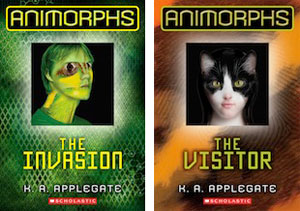
Scholastic is going to relaunch Animorphs.

That's seriously cool, for my nerdy self. I used to own them all, and have recently decided to try to recollect them. The covers look pretty sweet:


Count me as interested.

Thursday, September 9, 2010

Amish Proverbs: The Winner

So we had two entries for the Amish Proverbs contest. Here were the entries:

Derek:
"Advice is what we ask for when we already know the answer but wish we didn't."

Jason: "Proverbs are best understood after you have failed to heed their wisdom."


And so the winner (by random draw) is...


Derek! You can claim your prize anytime. Thanks to all for playing.

Thursday, August 26, 2010

Contest Update

Don't forget to enter a proverb to win a free book...

Free is good. Right now there's only one entry - reply to either this post or the original post to enter.

Tuesday, August 17, 2010

Free Giveaway: Amish Proverbs

Hello Blog Readers!

Who likes free stuff? Everyone, of course. Well, today you can win some free stuff right here on Thoughts on Life. What's up for grabs? A unique little gift book called "Amish Proverbs" by Suzanne Woods Fisher. Details on the contest follow this quick review.

Amish Proverbs is a hefty little book full of... amish proverbs! Mostly cute, sometimes funny, and frequently inspirational, it's a neat little coffee table book. As such, a proper review doesn't really befit this book, so I thought I would quote one excerpt I found that I rather liked.

"Some people never learn anything because they understand everything too soon."

I feel like that proverb describes me in many ways. I feel like I'm gifted with understanding, and too frequently I use that as a crutch to prevent myself from having to make any real change.
The book is full of little sayings like that. It's quite cute and quite meaningful at the same time.

So, now that you've read that excerpt, I bet you're thinking "how do I get my hands on a copy? It's only been out a week and a half!"

Well, here's how. Click the little comment button below this post and leave your name, along with a family proverb. The proverb doesn't need to be funny or meaningful or anything, but just something that was true that you heard growing up. Here's my example:

Andy Szymas - "Food is what's for dinner."

See? Simple! So click comment, leave your name and proverb, and I'll automatically enter you to win a free copy.

And as a special bonus to my loyal readers, if you are a follower of my blog, I'll give you an extra entry! That means you would have double the chance to win a free copy (which I will mail out in approximately two weeks time). If you're not a follower, you can just click the "Follow" button at the top of the screen and I'll give you an extra entry as well!

So - what's your proverb?

Tuesday, December 29, 2009

Introverts in the Church Review

Introverts in the Church Review by Adam McHugh

Adam McHugh has written a comprehensive review of introversion in the Church. Starting with a discussion about the dominance of extroversion in our culture and most particularly in the Church around us, McHugh then moves the reader through how introverts can find healing in the church, what introverts can offer the church as introverts, and how introverts can lead effectively without pretending to be extroverts.

I said this book was comprehensive – and it is. It is well written, and McHugh (an introvert himself) leaves no stones unturned. In particular, the opening chapter, in which McHugh explains how the Church is primarily extroverted., can be an eye opening experience – for an extrovert like me. It’s easy to look past how church is done and assume that the way I feel comfortable with is the correct way – and that’s not always true.

In fact, my only concern after reading this book is that it is written to introverts. As I was reading as an extrovert, if I read too much at once, I could walk away almost… depressed, for lack of a better term. It was overwhelming to see how little the Church does for introverts and how much it does do for extroverts. Seeing as how I believe this book is bringing some balance to an extremely unbalanced aspect of Church (and culture), I almost wish McHugh would write a companion book, to extroverts.

Even so, this book is a very important read. McHugh has explained so much that it helps me understand my introverted wife better – as well as other introverts I have relationships with. I recommend it as a read for anyone with introverts in their social circles (everyone) and anyone who interacts in large group settings (Church!). 4/5.

This review posted on Amazon.com and andyszymas.blogspot.com; I would like to thank Intervarsity Press for the review copy.

Tuesday, December 15, 2009

Fearless Review

Fearless by Max Lucado

The subject of Fear is one that dominates our society. Books, movies, entire industries are based in fear. Our culture seems to love to live in and around fear.
But how are we as Christians supposed to respond? The Scriptures tell us that we are to fear God only, and that any other fear has no place in our lives as Christians, called by God.
That’s the subject of Max Lucado’s latest book – appropriately titled Fearless. Lucado has long been a force in the Christian writing circles, and his latest work takes head – on one of the scariest subjects out there, and Lucado does it with all the grace and skill we’ve come to expect.
Lucado starts with “Why Are We Afraid” and turns the question on it’s head, and gently provokes thoughts and ideas on the subject. Lucado stays to his tried and tested formula of dispensing deep truth along with humor and sensible practical ideas, and has written another great book. 4/5.

This review posted on barnesandnoble.com and andyszymas.blogspot.com; thanks to Thomas Nelson for providing a review copy.

Give This Christmas Away Review

101 Simple & Thoughtful Ways to Give This Christmas Away by Matthew West

This was an interesting little book. I picked it up having low expectations, at best. Thoughtful little Christmas books tend to be just that - thoughtful, not practical. I hoped that this book by singer Matthew West might be more practical than most other little Christian "stocking stuffer" books.
Thankfully, "Give This Christmas Away" met me halfway. The book is just what it says - 101 simple ways to make someone else's Christmas. It's an extraordinarily quick book to read through, because each idea takes one page (and is sometimes a single paragraph).
West balances out thoughtful (if generally vague) suggestions (for example - #21 Comfort the Brokenhearted") with the practical ideas. #83, Donating to the Salvation Army Angel Tree, and #38, pick up random trash, are examples of some of the more thoroughly practical ideas.
All in all, it's a nice stocking stuffer. This would probably be a great thing to give to kids in whom you're trying to instill a spirit of giving during this Christmas Season. I give it a 4/5 - neat little stocking stuffer.

This review has been posted on andyszymas.blogspot.com and barnesannoble.com; thanks to Tyndale House for providing a review copy.

Evil and the Justice of God Review

Evil and the Justice of God by NT Wright
I suppose I find it hard to believe that I've never actually read a book by N.T. Wright. I've been aware of him for a long time, but I've never actually sat down to read any of his works. I've heard him quoted in books, in classes, in conversations, but until now, I didn't really know whether he was a good theologian or a good writer or both.
Now, I feel confident in saying that Wright is both. His theology (at least in Evil and the Justice of God) is quite strong, and it is clear he puts a lot of thought and research into his work. Yet Wright also manages to be understandable, which is something that many other theologians seem to lack. I felt comfortable reading his book without the Bible in one hand and a dictionary in the other, to say it in better words.
As for this book itself, I found it to be a great treatise on the problem of evil. It moves and flows in a very natural progression; from examining (that there is) the problem of evil, and moving towards solutions on personal and communal levels. I particularly liked Wrights conclusions about how Evil exhausted itself on the cross - that it spent everything it had in an still desperate attempt to tempt Jesus and failed.
All in all, an excellent book. I would give a book a good review for managing to make theology readable, and this book goes above and beyond that. Truely excellent, and I give it 5/5.

This review posted on andyszymas.blogspot.com and amazon.com; I wish to thank IVP for the review copy.

Monday, September 21, 2009

Jesus Nation Review

Jesus Nation by Joseph Stowell
Sometimes you have to ask who a book is written for. Frequently, the intended reader is not you.
But what do you do when you absolutely can't figure out who the intended reader is?
Such is the case with Joe Stowell's book, "Jesus Nation."
"Jesus Nation" is, at the heart, a book about belonging. A book about belonging to a nation, living and dying and breathing, with that nation, in much the same way as you follow your favorite sports team. Stowell is outlining what it means to have that same passion about following Jesus; about what life would look like if we looked up to Jesus even more than we look up to a Peyton Manning or a Steve Yzerman.
The main problem I had with this book was this: It didn't incite any sort of passion in me. I wondered if maybe I simply couldn't figure out who should be reading it, but all in all, it failed to make me dream about what the point was.
Please don't get me wrong. Stowell, by all accounts, is a great man, and is doing a wonderful job at Cornerstone University, my alma mater. And Stowell uses a few good analogies and metaphors throughout his book; ideas that were at least a little intrigueing, and deserved to be discussed and fleshed out.
But bottom line - I had to force myself to read it. It never captivated me, and thus I can only give it 2.5/5.
Reviewed for Tyndale House

Saturday, September 19, 2009

On Writing Review

On Writing by Stephen King

Stephen King is certainly one of, if not the, most famous authors of the current landscape. His works have sold, by estimate, 300-350 million copies.

Holy smokes. So when he has something to say about writing, or at least writing to people, I'll listen anyway.

And indeed, this half-autobiography half-creative writing text is very useful. His toolbox (the middle part of the book, full of writing tools), in particular, is of extreme interest to me.

Kings advice on characters, his advice on plot vs story, his advice on writing in general, is all useful advice. Indeed, his description of writing as telepathy is interesting and probably deserves a post of its own.

I give it 4/5, because I was less interested in the autobiographical first part of the book. Very useful book to pick up on writing though.

Thursday, September 17, 2009

There and Back Again Review

There and Back Again by Sean Astin, with Joe Layden

I'll be honest. I've always enjoyed seeing Sean Astin in films - even though I've never seen Rudy. So I saw this book chilling on a Goodwill shelf, and decided to pick it up. I really went Lord of the Rings Crazy when the trilogy came out, and I've always been interested in the backstory of the making of the film trilogy.

Second honest opinion. I've always enjoyed Sean Astin in films, but out of a film? He seems... like a guy that might annoy me in real life. And I think that's why he works so well as the underdog in his films; he has an earnestness that translates from real life to the screen. And that earnestness can sometimes bite him when he's not acting. Astin details a few of those stories in this book, and it helps make the book quite courageous - it's certainly a lot easier to tell funny anecdotes about Lord of the Rings, and much more difficult to talk about your character flaws.

There are quite a few funny anecdotes in this book. Reading about the hobbits cameraderie, is quite humorous. I walk away wishing I had been the fifth hobbit.

I recommend this book if you're interested in Lord of the Rings, or if you like Sean Astin. As a biography, it's not my favorite; it doesn't quite cover the range that someone like Michael J Fox's does. I give it 3.5/5 stars.

Wednesday, September 16, 2009

flashBANG Review

flashBANG by Mark Steele

Sometimes someone writes a book and you wonder if they were reading your mind.

flashBANG did that for me. In many ways, Mark Steele felt like he was reaching into my mind and giving words to what I already knew. In so many ways, he was definitely writing somethings I needed to hear.

So that was how I reacted. What is the book? What's it about?

Well, the subtitle is "How I got over myself," so that's an interesting place to start. But it's more than that too. It's a journey, from a 'flashbang' (a type of bomb that does exactly what it says -flashes and bangs but leaves no damage behind) to a 'spittake' to 'slaphappy.'

It's told through the lens of stories; from an unfortunate incident with a parakeet and a pot of spaghetti sauce, to a clumsy german missionary, to a doomed attempt to sell cologne door to door.

The book is creative and innovative; I particularly enjoyed reading Mark's humorous, sometimes bizarre, and frequently meaningful arguements with himself.

I give this book a five out of five. It's got a great message and meaning and journey, but it's also just ridiculously funny. I've never laughed so much while reading a book, and I frequently read books that are from the 'humor' section of the bookstore.

Enjoy it.

Saturday, September 12, 2009

From Peanuts to the Pressbox Review

From Peanuts to the Pressbox, by Eli Gold and M.B. Roberts


I enjoy sports. I enjoy watching them on TV, but very rarely do I give much thought to the people who are, as Eli Gold would say, putting captions on the pictures. Until now, I never realized how much work and preparation goes into what they are doing. From Peanuts to the Pressbox is a well-written and intriguing book, detailing the literal journey from a young boy selling peanuts and dreaming about sports broadcasting into one of the more famed modern sports broadcasters, with experience in the NHL, NFL, Nascar, AFL, and of course, as the Voice of the Alabama Tide.

I enjoyed reading Eli Gold’s stories and tales. He truly has a tremendous amount of experience and has had the opportunity to meet many people throughout his career; Joe Namath, Dale Earnhardt, and Kenny “the snake” Stabler. Some of the stories he can tell about these sport legends are amazing and heartwarming. In addition, the amount of research that Eli must have done is thrilling – a chance to learn the history behind broadcasting, not just his personal story.

The bottom line is this – if you’re interested in learning a bit about one of the most unnoticed aspects of sports, then From Peanuts to the Pressbox is a great book to pick up. I give it 4/5 stars.


Reviewed for Thomas Nelson Publishers.

Monday, September 7, 2009

Hey Neat-O - 10

I like books. They are good.

I like free. It is good.

I like free books. They are doubly good.

So what do I say to agreeing to write a review of a book to receive it free?

Heck yes. So shortly, you will start to see more book reviews on this blog. Many thanks to Jean Ballance for pointing this out. She has (and I have as well) attempted to contact other publishers, so I will let you know if I find any.

But also, you can do it yourself - just check out these websites:

Thomas Nelson


Tyndale House

Waterbrook Press

Thursday, October 16, 2008

Random Thoughts - 11

An Autobiography of Reading:

Bruce Coville
Bruce writes children's books, and I read them until I was 9 or 10. Loved them. Where else do you learn that aliens do indeed fart?
K.A. Applegate
Applegate was the author behind the Animorphs books, which I read until the series ended. They were a bridge to more adult books; the Animorphs dealt with some staggeringly adult themes; war and loss and ethics.
Christopher Pike
These were my real transition books. I remember reading one, and there was a swear word in the first chapter. I put the book away, terrified my parents would get mad at me. Eventually, I kept reading. I don't remember these books adding anything of value to my life, but they did prepare me for the next step.
Dean Koontz
Aah, the mindless thriller. Loved Dean Koontz. Still do, as a matter of fact. Something about his writing lets me just forget what it is I'm doing or what it is I'm worrying about. Some of his newer stuff has some good things to say against bioethics and stuff, so nowadays I don't see him as too much of a guilty pleasure.
Stephen King
And then we get to some of the heavyweights. King's books range from the terrifying to the thoughtful, and it was first through King that I learned that a story that stays with you is one that doesn't wrap up all the neat ends. I hate(d) that King would kill off certain characters, and I wanted to rewrite the story so that they lived. And then I realized how effective that was; I was so disturbed by the book that I found myself thinking about it long after I had read it. IT and The Stand are two of the best horror books I've ever read, and they have so much more to offer than just chills down your back.
COLLEGE
Funny enough, but I didn't read much of anything when I was in college. If I was reading, it was certainly for class, and not for the sake of reading.
Rob Bell
My first introduction into postmodernism, and I loved it. I fell too deep into it for a little while, and I needed to actually remember to read the Bible to make sure I wasn't just making crap up. Rob helped me to see postmodernity in a good light and how to balance it with the Bible.
Anne Lamott
I debated whether or not to put Donald Miller here, but I decided it would be more appropriate to go with Lamott. Lamott inspired Miller, afterall. And on my first reading of Blue Like Jazz, I didn't like it. I loved Bird by Bird (by Lamott) on the first read. I loved the realistic combined with the poetic, and the honest emotions. It helped inspire me to write Ashram, and ultimately to continue writing.

What's next?

Sunday, October 5, 2008

Jesus Wants to Save Christians Review

Jesus Wants to Save Christians
Rob Bell and Don Golden

I bought Rob Bell and Don Golden's new book recently. You might remember I posted a preview of the book, and thought it sounded very intriguing. I didn't know what to expect. And this book defied my expectations - it wasn't what I thought it was going to be at all.
Basically, Rob and Don outline a New Exodus theology. They describe how the entire Bible can be told in parallel to the story of the Exodus, and the Passover in particular.
I always sort of understood that the passover was significant, but I never paid attention to it. I have always been interested in the power of communion, and I never made the connection, like the authors do, between communion and passover. There is a reason that Jesus initiates communion on the Passover; he is drawing connection between his person and the lamb slain at passover.
If you're unfamiliar with New Exodus theology, this is a great book to start with. As far as I understand, this acts like a basic primer to this theology. For those who want to paint Rob (and Mars Hill) into an emergent and theological-less corner, this book closes that idea pretty thoroughly. Rob obviously has a theology, and here he has articulated it clearly.
Some thoughts:
There are some scathing indictments of America in here, so if your the ultra-patriotic America-is-God type, you may not enjoy this. There are also some jabs at the modern evangelical church.
Ben Witherington III has a great review. He points out some of the great thinking, as well as some of the issues where Rob and Don are off the mark, specifically regarding Philip and the Ethiopian.
I think that "Blood on the Doorposts of the Universe" is an appropriately epic chapter title.
If you were used to Rob's storytelling approach, you may be in for some shock here. This book has none of the stories that Rob used to such great extent in Sex God and Velvet Elvis. Another reason why it was not what I expected.
The Bottom line:
I really liked this book. Definitely Recommend it. I would make sure, as with all things, to do some research and not just blindly accept everything it it (another reason to read Ben Witherington). But bottom line - read it.

Tuesday, April 1, 2008

Description of Rob Bell's Next Book:

Jesus Wants To Save Christians
by Rob Bell and Don Golden

There is a church not too far from us that recently added a $25 million addition to their building.

Our local newspaper ran a front-page story not too long ago about a study revealing that one in five people in our city lives in poverty.

This is a book about those two numbers.

It's a book about faith and fear,

wealth and war,

poverty, power, safety, terror,

Bibles, bombs, and homeland insecurity,

It's about empty empires and the truth that everybody's a priest, it's about oppression, occupation, and what happens when Christians support, animate and participate in the very things Jesus came to set people free from.

It's about what it means to be a part of the church of Jesus in a world where some people fly planes into buildings while others pick up groceries in Hummers.


October, 2008